

Building a World for Everyone
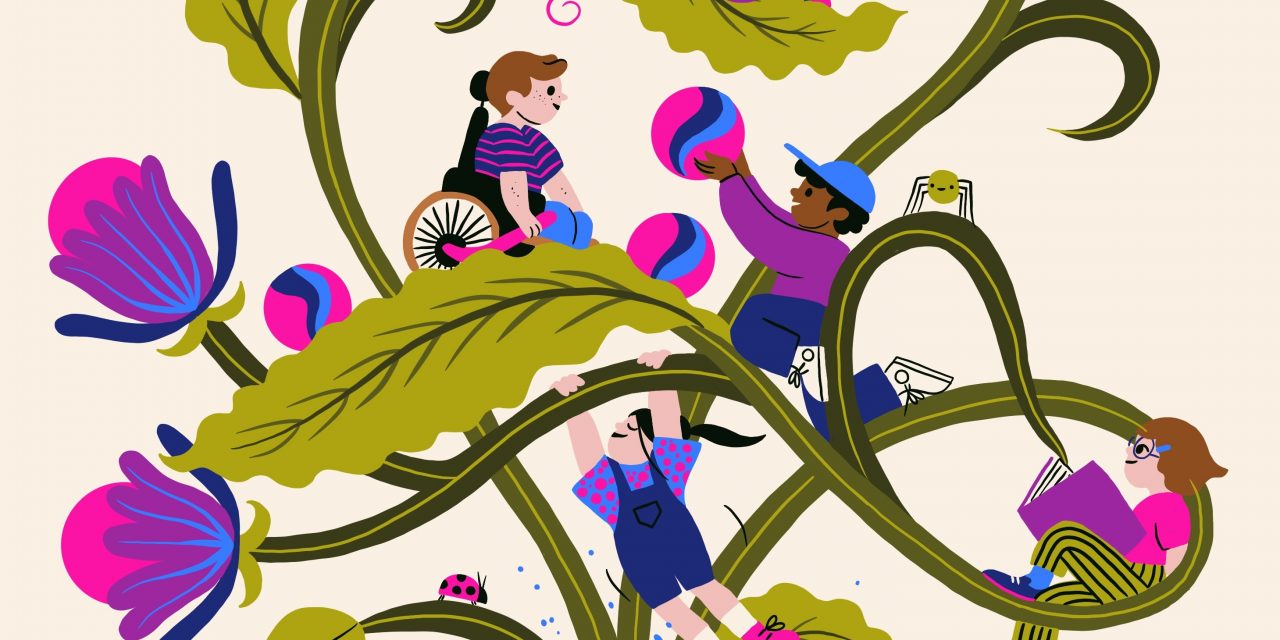
From classrooms to playgrounds—and beyond—Milton’s first-graders design solutions to make the world more welcoming.
By Marisa Donelan
Illustration by Karoline Schnoor
What happens when the only entrance to a children’s museum is a stairway? Or when directions around a park are color-coded? Or when a card game requires players to use two hands?
Those situations mean that not everyone can play, Milton’s Grade 1 students learned this year. So they set about finding solutions and dreaming up possibilities—using what they learned in social studies and other subjects—to make communities more inclusive and functional for all.
“This is the time when we’re planting the seed to have the students think about their role in their broader community,” says Shannon Kilduff, one of Milton’s two Grade 1 teachers. “We’re asking them to think about their stewardship of their own communities, and what they can do to make them better.”
Applying lessons from a unit about simple machines, insight gleaned from conversations with people who have physical differences, basic classroom supplies, and more than a little creativity, the students designed adaptive zipper pulls and utensils, page-turning devices for readers, and appropriate surfaces and grades for mobility ramps.
“Learning the basic principles of the simple machines and their movements helped us think about the ways that buildings and communities function, and it dovetails nicely with science,” Kilduff says. “Eventually, we’d love to have them work with Upper School students to learn more about physics and design.”
One afternoon in April, Kilduff and fellow Grade 1 teacher Caroline Sacchetti set up an experiment for the students to roll marbles on ramps with various surfaces designed to create different levels of friction. After repeatedly measuring how quickly and how far the marbles traveled down the ramps, the students concluded that a fairly smooth surface with a little bit of resistance would be the best and safest for wheelchair users.
“They’re learning to look outside their own needs, and these projects help them to think of others,” says Sacchetti. “They’re seeing that not everyone experiences the world the same way, but they’re also learning that they have the agency to make changes for a greater good.”
Considering the ways the world functions for all people, of all abilities, is part of a year-long, interdisciplinary program to develop students’ understanding of communities beyond the small circles of their families and peers. The program is tailored to the students’ developmental stage and starts at the beginning of the year to allow time for them to reflect on themselves and what makes them feel a sense of belonging in a community. Through discussions about friendship and collaborating during team-building challenges, they learn to notice and leverage the strengths they bring to the table.
By midyear, the curriculum shifts to looking at the larger Milton community. Using the collaborative skills the students honed in the fall, they build and run a Lower School post office as part of a letter-writing unit. Through customer service, the students learn to listen and respond to the needs of others and find stewardship in helping their community.
Nearly all children develop some sense of connection to others very early—babies and toddlers may smile when a parent smiles at them, or a child may try to soothe another who is upset. As preschoolers, they begin to understand their belonging to their families, and by the end of first grade they start to develop a sense of community and identity. They recognize the different roles people play in a society and begin to see how actions and structures affect people.
Eventually, through academic classes and cocurricular offerings, the students learn about how they fit into a school community; how housing, public resources, and businesses serve (or fail to serve) their populations; their own impact on the environment; and the different cultures that make up a global society.
“They’re still very much in their bubbles, but they start to look outside of them,” Kilduff says of the shift that happens over the course of first grade. “They’re still trying to make connections between their experiences and other people’s experiences—they think a lot about fairness and what’s fair to them—but they’re starting to acknowledge that they belong to a larger community.”
In early February, the students had a visit from the Bionic Project, a Cambridge-based nonprofit that works with schools to dismantle disability bias and support inclusive communities. The program introduced Milton students to the adaptive tools that disabled athletes use and showed the impact of technological advancements in the lives of people with disabilities. Most importantly, students learned that given the right settings, all kids can play and learn together.
Connecting accessibility concepts to the students’ interests, like sports and games, has kept the students engaged and incredibly creative with their ideas for adaptive innovations, Sacchetti says. In their prototypes for tools to help people with limited hand mobility, for example, several students designed devices very similar to ones that are already in use.
“They relate to these subjects because they play soccer, they play Uno,” she says. “It makes them think about sharing what they love to do, and on their own they’ve come up with ideas that have real-world applications.”
Lessons also take students out of the classroom. In one unit, they explored school spaces to identify barriers. Looking at stairwells, furniture placement, and the location of everyday tools, they found potential barriers and then developed plans to make these spaces more accessible to all.
Examining everyday playground structures, the students used what they had learned about simple machines, friction, and universal design to reconceptualize and adapt the apparatus to meet the physical needs of students with varying abilities.
“They’ve started to notice and point out things that are barriers to accessibility,” Kilduff says. “They are putting themselves into that new perspective and thinking about how businesses and spaces work for people. It’s becoming part of their thought process: ‘What needs to change or improve so that everyone can participate?’”
Later in the spring, the class visited the Universal Playground in Waltham, Massachusetts, a popular, 120-acre public park that opened in 2025. The playground was designed with structures and surfaces that allow kids who use wheelchairs or other assistive devices to use every attraction—from swings and splash pads to mini golf—along with their non-disabled peers.
As they reflected on their visit to the Universal Playground, Kilduff asked the class why they thought “universal” was in its name.
“So kids with disabilities can play!” one student answered. Another added: “So everyone can play together.”