



The Milton Equation
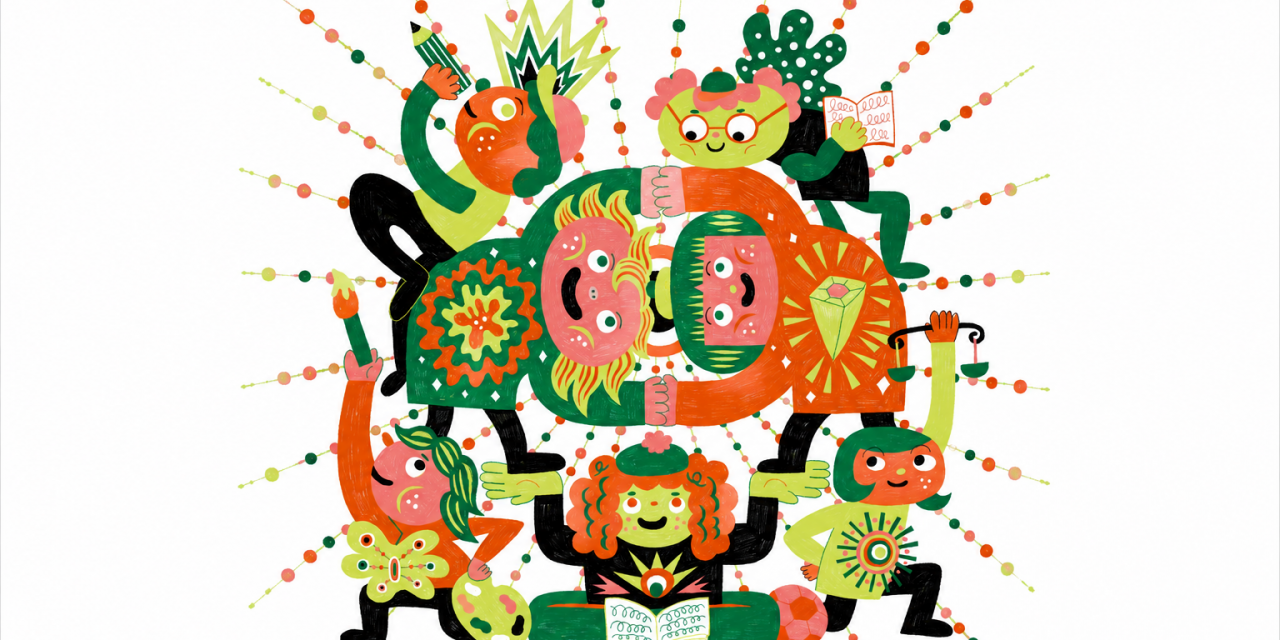
The combination of agency, knowledge, and ethics remains the school’s most powerful formula for preparing students to shape the world.
By Alixe Callen ’88, Head of School
Illustration by Aya Kakeda
The term “agency” seems to be having a moment. I have read articles hailing (and others decrying) so-called “high agency.” Apparently, in addition to IQ and EQ, employers should be hiring people with high AQ (agency quotient). I often say that Milton is where I developed my own sense of agency. Indeed, Milton has long turned out graduates who have demonstrated an ability to make things happen. We recognize that alongside our best-in-class education comes a responsibility to give back, to make a difference. The vast accomplishments of our alumni are living evidence of the power of that messaging.
But as we all know, agency alone can be dangerous. In my last piece for Milton Magazine, I wrote about Milton’s historical commitment to the ethical development of its students. In classrooms, around the tables in Forbes, on our stages and fields, in our student newspapers, students are constantly honing their own moral compasses, ensuring that they have developed a personal sense of right and wrong.
Alongside agency and ethics, Milton has also embraced the importance and power of knowledge, believing that both the attainment and the application of knowledge to real-life problems are critical pursuits. Milton’s campus is a place where it’s cool to be smart.
Here, these three ideals—knowledge, agency, and ethics—exist in a tightly calibrated triangle. Milton students and graduates know that knowledge or ethics without agency is useless. Agency without knowledge or ethics is dangerous. Around our Harkness tables and within their assignments and feedback, Milton teachers push our students to develop all three ideals.
And the results are impressive. Our alumni know how to use their success for good—as mentors, heads of foundations, donors to Milton, and those who use their considerable talents and education in the halls of power. While we regularly bring these alumni back to campus to share their impact with students, as part of a new initiative, we have extended that opportunity to Milton alumni and families. In a series of events around the country, alumni and families have gathered to hear from Milton graduates whose work illustrates these ideals of knowledge, agency, and ethics. At an event at the National Press Club in Washington, D.C., this spring, United States Representative Seth Magaziner ’02 and Brookings Institution Fellow Tonantzin Carmona ’08 discussed the ways that Milton prepared them to take on the domestic issues of our time. In New York City, three alumni discussed the impact of AI on our financial systems. In Los Angeles, alumni heard from Betsy Beers ’75 and Celeste Hughey ’04, both of whom are successful women—writers and showrunners—in the entertainment industry.
This issue features examples of Milton grads who are living lives of deep purpose, embodying the knowledge, ethics, and agency they developed here on Centre Street. They are leaders at the tops of their fields who demonstrate these ideals in their ability to thoughtfully adapt to a constantly changing world, their embrace of thorny challenges, and their confidence in making difficult decisions.
In these pages you will also find the stories of young Milton people already living these values—a recent alumnus managing a full-time college schedule while running his own business; current students getting a jump on real-world economic and financial experience; and Lower School students investigating smart solutions to make communities work better for people of all abilities.
These stories give me hope.
What’s especially powerful to me is that these values of knowledge, agency, and ethics are so commonly held across our community: There are newsmakers and industry leaders among us, of course, and teachers, policymakers, scientists, and artists living these ideals every day. There are students whose hunger for learning—and the inspiration that curiosity brings them—drives them toward purpose and meaningful action well before they cross the stage at Graduation.
Today’s world needs smart people with the agency to take on major challenges and the ethical foundation to lead with integrity. We live in a time of great disruption and confusion: a “post-truth” landscape that affects every aspect of our society, including a disheartening erosion of trust in educational institutions. I believe that Milton and schools like it hold a powerful antidote to many of the problems we face. We have students who refuse to shy away from hard things and educators who look beyond what’s always been done to step bravely toward what’s possible.
The proof is in our people—our young learners who are expanding their knowledge, agency, and ethical development all the time, and our fellow alumni who live these ideals in their work and their passions. As I write, Milton is preparing to launch a new group of graduates ready to bring these values into the world beyond campus. I can’t wait to see what they’ll do.