



The Economist in the Arena
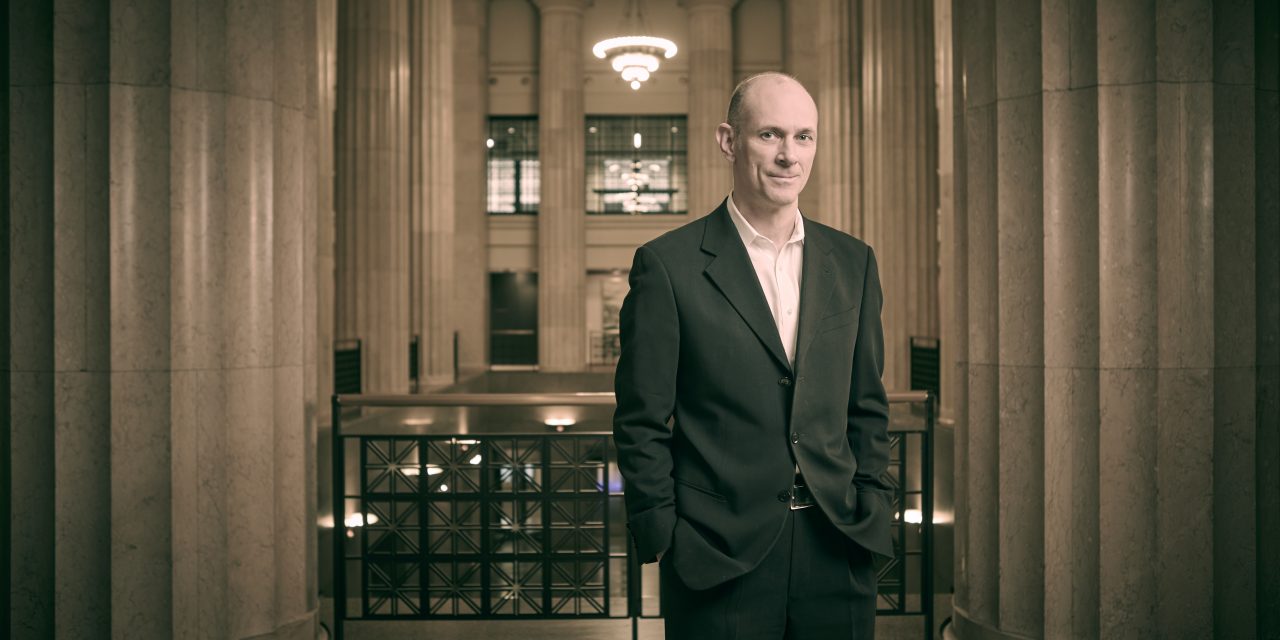
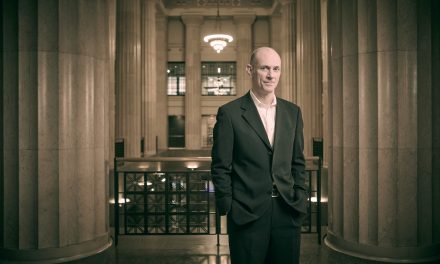
From Milton’s speech and debate team to the White House to the Chicago Fed, Austan Goolsbee ’87 has spent his career applying economic theory to real-world challenges.
By Alexander Gelfand
Photograph by Jeff Sciortino
Austan Goolsbee ’87, president and CEO of the Federal Reserve Bank of Chicago, would like you to know something about the Federal Reserve System.
Actually, he’d like you to know anything about the Federal Reserve System.
“In polling, the majority of people say they don’t know what the Fed does, yet an even bigger majority says whatever the Fed does, they think it’s doing a bad job,” Goolsbee says.
This is a problem, insofar as the Federal Reserve is one of the most important economic institutions in the country.
Established in 1913 under the Federal Reserve Act, the Fed acts as the central bank of the United States, with a so-called dual mandate to promote maximum employment and stable prices. It includes a Board of Governors based in Washington, D.C., and 12 Regional Federal Reserve Banks that serve districts made up of multiple states (the Chicago Fed, for example, serves the 7th District, which comprises a large chunk of the Midwest). Together, they make up the Federal Open Market Committee, which sets monetary policy by adjusting interest rates.
As Goolsbee explains, the creation of a decentralized network of regional reserve banks was intended to prevent control of the financial system from falling completely into the hands of Washington and Wall Street. Instead, institutions like the Chicago Fed—which serves more than 35 million people across Illinois, Indiana, Iowa, Michigan, and Wisconsin—ensure that the Federal Reserve System receives independent input on the state of the economy from other parts of the country.
Yet on a day-to-day basis, the regional reserve banks are responsible for a lot more than that. The Chicago Fed’s more than 1,600 employees do everything from supervising member banks and supplying them with cash (“We’ve got tens of billions of dollars in the basement, and armored cars come in and out every day,” Goolsbee says) to conducting economic research and engaging with local communities. That last role includes promoting community development—under Goolsbee, the Chicago Fed has explored housing affordability, elderly financial exploitation, and how challenges in finding affordable childcare affect people’s ability to join the workforce.
For Goolsbee, the Fed’s public-facing role has become especially important given what he describes as the “massive crisis of public trust in institutions” currently roiling the United States.
“People are suspicious of elite institutions. They’re suspicious of government. And the Fed is in the Venn diagram of suspicion,” Goolsbee says.
As a result, Goolsbee has made a point of engaging the public whenever possible, whether that means talking to the national media about the importance of protecting the Fed’s independence from political influence or it means explaining the Fed’s various functions to audiences at events in places like Cedar Rapids, Iowa, and Grand Rapids, Michigan.
It is, he says, all part of the “Fed demystification project.”
“The Fed has always had an ethos that external engagement was succeeding the less anyone said about the Fed; if nobody said anything about it, then that was a victory,” Goolsbee says. “And I think right now, that’s really dangerous.”
Goolsbee is no stranger to crisis.
As former chairman of President Barack Obama’s Council of Economic Advisers and chief economist to the President’s Economic Recovery Advisory Board following the 2008 financial meltdown, he helped steer the U.S. out of the worst economic downturn since the Great Depression.
Goolsbee’s time in the White House grew out of his role as economic advisor to Obama’s first presidential campaign, which can in turn be traced to his work as a professor of economics at the University of Chicago’s Booth School of Business, where he spent 30 years on the faculty before “retiring” to the Chicago Fed.
Every story has to start somewhere, however. And Goolsbee is clear about where his began.
“It absolutely goes back to Milton Academy,” he says.
Born in Texas and raised in California, Goolsbee arrived at Milton as an academically precocious, self-described “math kid.” The school’s speech and debate program kindled in him a passion for extemporaneous speaking (he won the 1987 National Speech and Debate Association championship), which in turn sparked an interest in current events.
“It seemed like economics was a combination of math and science and current events,” he says. “So I started thinking, maybe I could be an economist when I grew up.”
When he told college counselor Susan Case about his plan, she began to laugh.
“Why is that funny?” Goolsbee asked.
“Well,” Case replied, “I know somebody who can help you do that.”
The somebody was her husband, pioneering economist Karl E. Case, codeveloper of the S&P Case-Shiller index of home prices. Case introduced him to the National Bureau of Economic Research in Cambridge and economists at the Federal Reserve Bank of Boston, where he got a job as a research assistant while he was still at Milton.
“Milton changed the trajectory of my life,” Goolsbee says. “I found economics, and I found myself.”
Goolsbee went on to study economics at Yale with Nobel Laureate James Tobin, whose career as a scholar and public servant—Tobin served on John F. Kennedy’s Council of Economic Advisers and as a consultant to the Board of Governors of the Federal Reserve—foreshadowed his own.
After earning his Ph.D. from MIT in 1995, Goolsbee landed a faculty position at the University of Chicago—or as he calls it, “paradise on earth for economics.” Then, as now, his interests leaned toward public economics, which includes topics such as taxation and regulation, and industrial organization, which focuses on particular industries; and with the dot-com boom solidly underway, he began publishing some of the first papers to consider competition and taxes in the age of the internet, eventually testifying before Congress on the subject of e-commerce taxation.
Goolsbee’s rising profile in matters of economic policy attracted the attention of Barack Obama’s 2004 campaign for U.S. Senate. At the time, Obama was Goolsbee’s state senator as well as a lecturer at the University of Chicago Law School. But Michelle Obama, who was then an executive with the University of Chicago Hospitals, had a much higher profile on campus. By contrast, her husband was primarily “a guy I knew from birthday parties,” since Goolsbee’s oldest child attended the same school as the Obamas’ children. Nonetheless, Goolsbee agreed to advise Obama on economic policy; and several years later, when Obama ran for president, he asked Goolsbee if he’d do so again.
Only this time, Goolsbee hesitated.
“I said, ‘Well, my research is very important; I don’t know if I have time to work on this,’” he recalls.
In the end, Goolsbee’s wife, Robin, persuaded him to do it anyhow. She told him that he’d kick himself if Obama lost and he hadn’t done a thing to help him, which Goolsbee admits was probably true.
By the time Obama took office, the 2008 financial crisis was in full swing, and Goolsbee found himself not only serving on the Council of Economic Advisers but also acting as chief economist and chief of staff to the President’s Economic Recovery Advisory Board. The initial shock to the economy, says Goolsbee, was even worse than the Stock Market Crash of 1929, forcing him and his colleagues to confront a series of momentous questions with no clear answers: Can the crisis play out without the nation’s banks collapsing, or will they have to be nationalized? Can the auto industry be rescued, or is it doomed?
Goolsbee had to turn economic theory into practice in the most high-stakes scenario imaginable.
“It was a great comfort to know that at the end of the day, the president was the one who had to make these decisions—because not a single one of them was easy.”
By 2011, the situation had stabilized and Goolsbee’s leave of absence from the University of Chicago was set to expire, leaving him a clear choice: stay in D.C. and continue working in government, or return to Chicago and the groves of academe.
“I went back to the university, because that was my first love,” he says.
But leaving government didn’t mean walking away from the public sphere.
In addition to putting his speaking skills to good use explaining—and often defending—the Obama administration’s economic policies through media appearances in outlets ranging from The Daily Show to Fox News, Goolsbee acted as an advisor to the Federal Reserve Bank of New York, the U.S. Department of Commerce, and the International Monetary Fund. He also became heavily involved in education.
“Scratch any economist and you’ll end up with ‘the greatest investment we can make is in the education of the future workforce and our kids,’” Goolsbee says, noting that he served on the board of a network of charter schools run by the University of Chicago long before heading to D.C.
He also served on Milton’s Board of Trustees.
But Goolsbee’s stint in the Obama administration meant that a variety of suitors came calling, leading him to become a director at both the Lumina Foundation, which focuses on increasing access to college, and the Chicago Public Education Fund, which supports the training and development of principals. He was also appointed to the Chicago Board of Education.
In 2022, however, Goolsbee’s predecessor at the Chicago Fed, Charles L. Evans, reached mandatory retirement age. And despite the sometimes harrowing nature of his previous work in government, Goolsbee yearned to immerse himself once again in the mission-driven milieu of full-time public service.
“I did miss that clarity,” he says of his tenure in the White House. “For all the frustrations and all the stress, it was obvious that the work was really important.”
In the end, taking up the Federal Reserve’s clearly defined dual mandate of stabilizing prices and maximizing employment, or what he calls “the narrow Fed lane,” proved impossible to resist.
He just passed his three-year anniversary in the role, and in December, he was reappointed to a five-year term.
“It’s still a thrill each day walking by the machines where there’s hundreds of millions of dollars of cash running, and thinking about this narrow Fed lane,” he says. “That’s still very much my lane—ever since my Milton days—combining math and science with current affairs.”
Alexander Gelfand is a freelance journalist living in New York City whose work has appeared in such publications as Wired, The Economist, and The New York Times.