

Challenge Accepted

AS CEO OF CENTENE, SARAH LONDON ’98 CONFRONTS HEALTH CARE’S TOUGHEST MORAL AND FINANCIAL QUESTIONS.
Story by Kimberly Ashton
Photographs by Brian Cummings
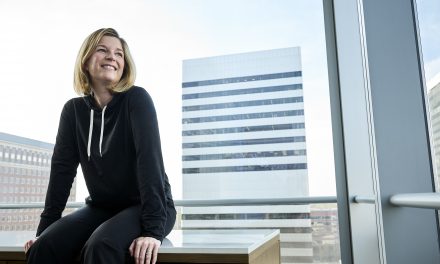
The American health care system is a Gordian knot tying together human lives, big business, and the U.S. government. By most measures, it’s the most complicated in the world, bedeviling presidents, baffling economists, and frustrating, well, everybody. It’s no wonder Sarah London ’98 was drawn to it.
“The idea of working on something that’s really, really hard and has an impact is incredibly rewarding,” says London, the CEO of Centene, a Fortune 25 company and the nation’s largest Medicaid and Medicare managed care company.
For someone who loves a challenge, London could hardly have picked a better time to ascend to the top job at Centene: The past several years have been remarkably tumultuous in the health care industry, particularly for organizations that serve lower-income Americans. Costs have surged, COVID-era allowances for Medicaid eligibility came to an end, and enhanced Affordable Care Act (ACA) subsidies expired.
When she took the job, in 2022, she was 41 and the youngest female CEO in the Fortune 500. During her first year, she redirected Centene’s focus from relentless growth to the core mission of serving people who rely on government-sponsored health care. The following year, she landed on the Fortune Most Powerful Women in Business list.
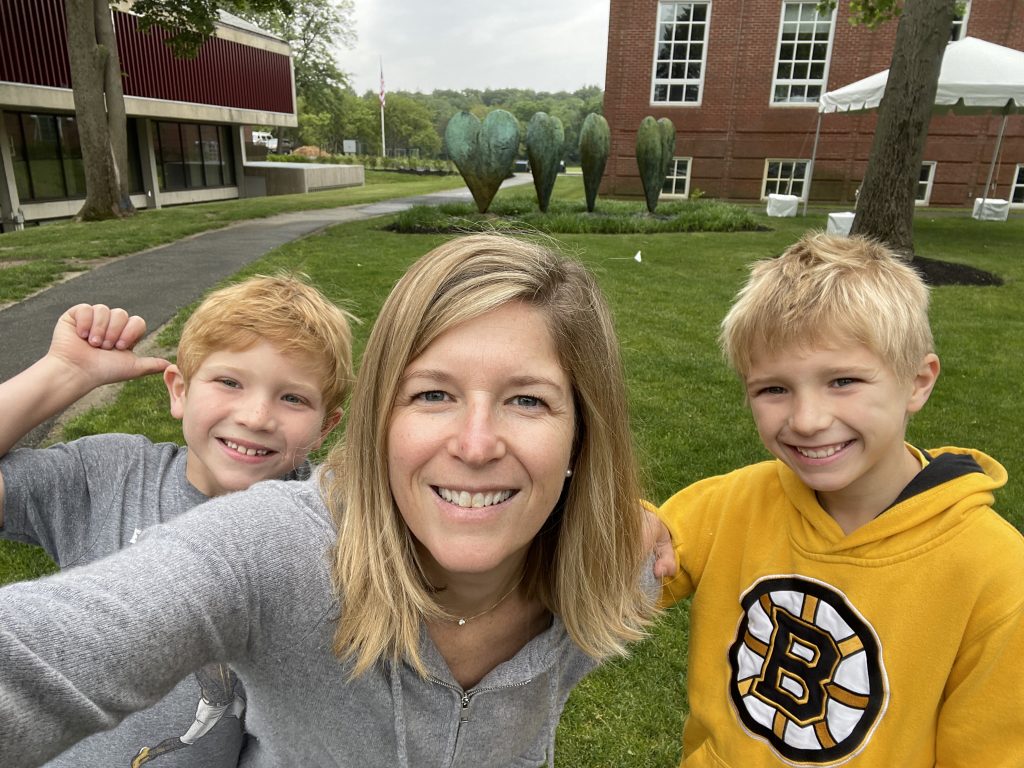
Sarah London ’98 with her sons at her 25th Milton Reunion.
Much of London’s attraction to tackling tough-to-solve problems can be traced back to her time at Milton. “It challenged you, and there were no easy passes,” she says. “And it rewarded and reinforced when you stepped up to that challenge, and built competence that built confidence—not ego, but just, ‘Okay, I can do hard things. I can balance a lot of work. I can think about something differently. I can come up with a new idea.’”
She remembers doing homework in the library one day during her junior year when her chemistry teacher, Bob Tyler, approached her and asked if she planned to take Honors Biology.
“I was like, ‘No, it’s really hard. It’s supposed to be really hard,’” she recalls telling him. “And he basically was like, ‘No, you have to.’” She pushed back, saying her course load was already tough and that regular bio was fine. “But he said, ‘No, you can’t…I’m not going to let you take a pass.’ And it ended up being one of my favorite classes because it was insanely challenging, and so to actually figure it out was so gratifying,” she says.
What stood out to her about Tyler’s encouragement was how much he cared, despite her feeling like “just another chemistry student” in the class. Tyler wasn’t the only one. London says she could give plenty of other examples of teachers who were invested in her success, and who “saw their role as helping to develop and push and sort of say, ‘You are capable of more.’ And I just loved it.”
She entered Milton at the start of seventh grade, having moved with her family from Northern New Jersey to Boston after her mother got a job teaching writing at Harvard University. London remembers going to a welcome party organized by class parents; the first person she met there became one of her closest friends at Milton. “The speed with which I ended up finding my people was just weird,” she says. “I found this group, and we were referred to as the DSGs, the Day Student Girls, because we were just a group of nerds, basically, and we loved it, and we didn’t care.”
Each girl had her own interests and points of view but they all had one thing in common: “We really, really cared about school,” London says. They liked to hang out and do homework together but also leaned into their individualism. “One of the cool things about Milton at the time I was there, it was really okay to be whoever you were,” she says, remembering that she and her friends spent a lot of time watching Dawson’s Creek while eating cookie dough but would also get into “just very vehement debates about, like, Israeli foreign policy…we would disagree and debate. And it really sharpened our minds and perspectives.” They had different opinions but the same values: diligence, hard work, and being true to themselves. “It’s like being on an A-team.”
After graduating, London went to Harvard, where she played Division I tennis and majored in history and literature, focusing on Britain and France in the World War II era. The major had no required classes so students had to create their own curriculum. London liked that she got to explore an array of subjects and figure out how they were all connected.
Fresh out of Harvard, she turned down a job at Goldman Sachs and headed to Hollywood, “deeply horrifying my father,” who worked in finance. Working in the film industry seemed to her like a good way to feed the part of her that wrote poetry as well as the part of her that was drawn to the business world.
London got a job in a talent agency, where she learned “literally how to get anything done. It was the greatest lesson in adulting that you could ever have.” But she realized that while she liked movies, she didn’t have the passion for them it would take to sustain a career in the industry. “And, so, I went back to Boston and ended up getting hooked on health care,” she says.
She started working as a director of special projects for a nonprofit, venture-backed health care startup called Project Health (now Health Leads), which was founded by a fellow Harvard graduate. It was one of the earliest models around community health workers, focused on the safety-net population at Boston Medical Center. The idea was that college students would connect families to resources that could help these families overcome barriers to getting healthier.
For example, London explains, children would come back to the ER repeatedly for asthma attacks—they had inhalers and knew how to use them, but lived in substandard housing with cockroaches and mold that irritated their lungs. Or children would come in with diabetes whose families were living in cars, so they had no place to refrigerate insulin. For London, the experience sparked a deep interest in using information to improve health care for underserved populations.
Around that same time, medical records were being digitized, making it possible to look at both clinical data and billing data. She could see how this information—from population-level trends to asking a mother if she had a refrigerator at home—was going to change medical care entirely.
London decided to go to business school to figure out what a career at the intersection of health care and data could look like. She chose the University of Chicago for its curriculum and found that it reminded her of Milton.
“It was all about teaching you how to think, not what to think,” she says. “When I applied to the school, their motto was ‘Challenge Everything,’ which is a lot like ‘Dare to be true,’ right? And so that has become a personal motto and a mentality for me—not to be difficult, but to ask, ‘Is there a better way? Why is this the way it is? How do we push the boundary?’”
After earning an MBA, she took a job at Humedica (which later got acquired by Optum). The company, she says, was at the leading edge of helping health systems figure out how to use data to manage medical care in a value-based way and to reduce costs.
“I fell in love with…which is weird to say, but I did, I fell in love with data,” she says.
Over seven years, she moved through client services, management, and operations before joining Optum Ventures, where she focused on helping health care go through the kind of digital revolution that had transformed financial services.
In 2020, a role at Centene opened that London describes as “this magical confluence of all the things that had been part of my career from the very beginning.” She’d be working in technology strategy and modernization, and for a company that served, at the time, 28 million Americans.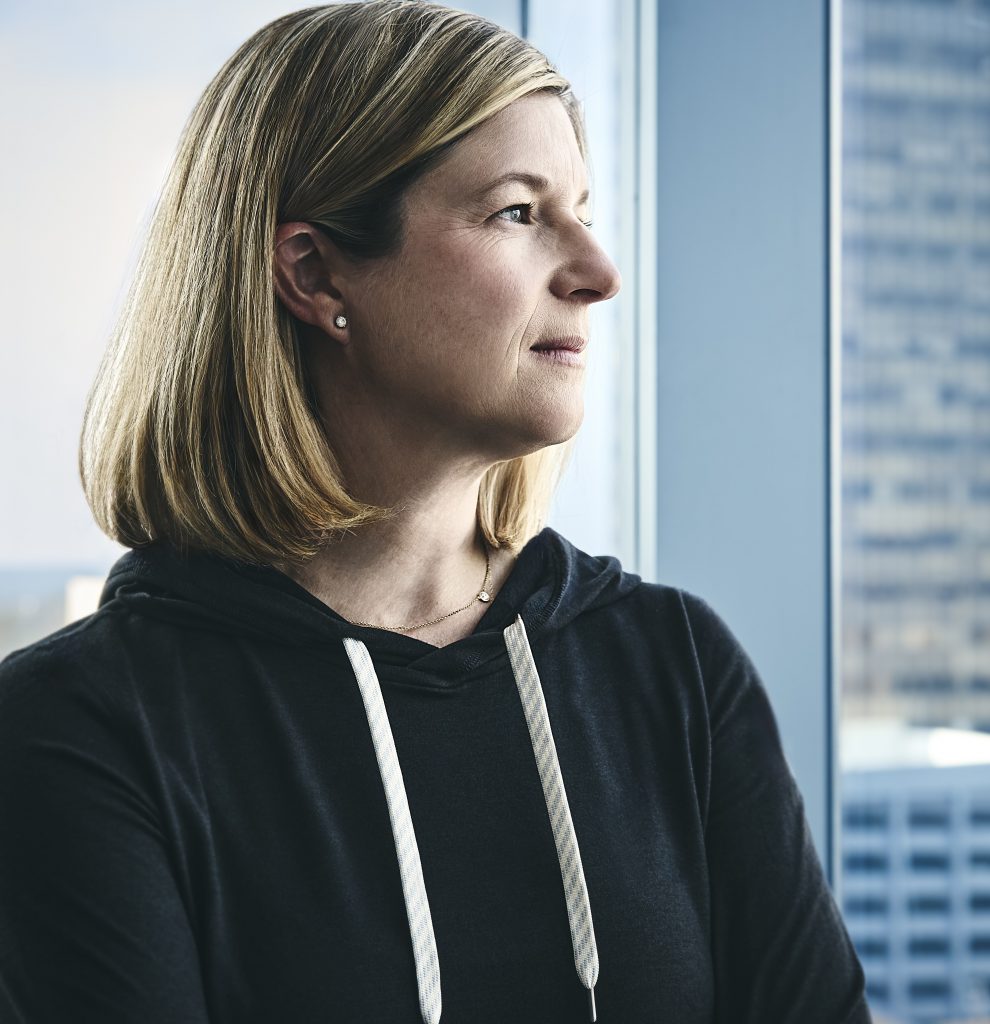
“Health care is an industry that can be incredibly entrenched. And so you need incumbents to lean in and crack the door open for innovation to actually take root and scale,” she says. For London, that meant ensuring the benefits reached low-income, medically complex Americans—people who are often the last to see the gains from innovation in the industry.
In just two years, she rose from senior vice president to vice chairman to CEO. She took over from a predecessor who had built the company from a $40 million single-state entity into a $140 billion national enterprise within 25 years.
London says she felt an incredible sense of responsibility to meet the expectations of Centene’s members, customers, and shareholders. But what she was most nervous about, she says, is what she calls the “moral hazard question.”
“This is the idea that you’re running a public company that needs to deliver sustainable profitability, and you are serving a vulnerable population,” she says. “The reality is that even in a nonprofit, you can’t do it without margin, because you have to be able to invest in the capabilities that you can bring forward to members.”
In guiding the work of Centene’s roughly 60,000 employees, London prioritizes transparency and communication, and makes a point to meet with people at all levels of the organization to get candid feedback on what’s working and what’s not. Particularly in 2025, which she describes as an exceptionally challenging year for the industry and for Centene, she felt an intense desire to communicate frequently with employees.
“Painting a vision, painting the where-we’re-going-and-why…is a powerful organizing force. It carries the gravity of almost an orbiting planet. It’s like, ‘We’re going to the moon.’ And there’s a gravitational pull to that,” London said in a February interview with CNBC.
The most rewarding part of her job, she says, is being part of a mission-driven team: “It’s one of those teams that, like back in seventh grade, I got to be part of. I’m around people every day who are smarter than I am and who work their butts off and really, really care and want to solve problems together.”
And while she describes herself as “not always an optimist,” the dedication she sees around her to improve American health care, combined with the revolutionary power of artificial intelligence to provide better data and lower costs, gives her reason for hope.
“But, you know,” she adds, “take that with a grain of salt, because I really like hard things.”
Kimberly Ashton is a freelance writer and editor whose work focuses on storytelling for educational institutions. She is the former editor of Berklee Today, and has written for The Associated Press and The Boston Globe.