

Doing Science at the Cutting Edge

Advanced science courses inspire students and faculty to work across disciplines and look well beyond Centre Street.
Story by Grace Tatter
Since the fall of 2010, Upper School science classes have been held in the gleaming, glass Pritzker Science Center, whose architecture makes the Science Department’s ethos clear.
“We learn by doing,” says Julie Seplaki, a teacher in the department since 2011, and its former chair. “The building was designed so that when you walk into Pritzker Science Center, you see students doing science.”
The types of science you might see students doing range from testing their own DNA to gene editing yeast with CRISPR to investigating oxidative stress and inflammatory responses in tetrahymena cells—research powered by their own inquiry and grounded in transdisciplinary courses including Disease Biophysics, a course Seplaki developed and teaches, and Molecular Genetics, which is taught by Michael Edgar, who designed the course and led the department for 13 years.
Seplaki was drawn to Milton as an instructor because of its “learning by doing” philosophy, and because she knew that it was a place where the richness and depth of the sciences is recognized. Rather than chopping science up into separate disciplines—chemistry, physics, and biology—and divorcing scientific concepts from important context, courses like Disease Biophysics recognize the intersectional and transdisciplinary nature of real-world scientific problems. The course deliberately draws from engineering and visual arts curricula to expand and enrich students’ skill sets and habits of mind.
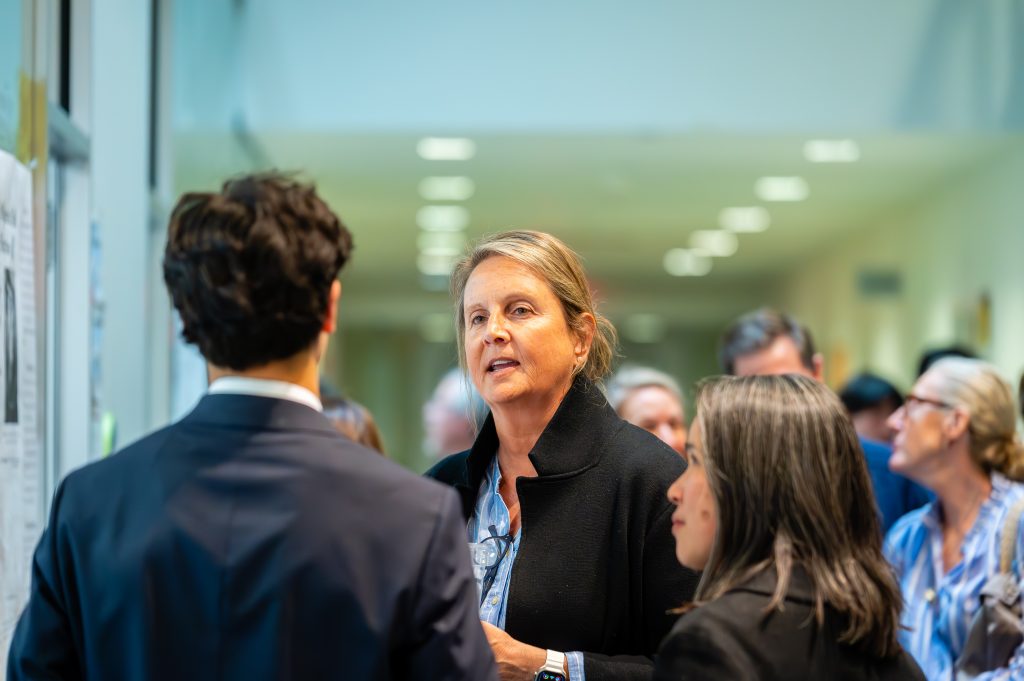 Milton has another advantage: its proximity to cutting-edge scientific research at universities like MIT and Harvard. “I’ve been able to engage in conversations with practitioners in medicine, education, and research, which has fueled more questions in my mind and has really helped to inform the kinds of curriculum and pedagogy that my students experience in the classroom,” says Seplaki. She leveraged the laboratories at Milton’s doorstep to create the Disease Biophysics curriculum. Several years ago, she was listening to an NPR interview with Kit Parker, the Tarr Family Professor of Bioengineering and principal investigator of the Disease Biophysics Group at the Harvard School of Engineering and Applied Sciences. Parker described his fascinating research involving the use of light to control intracellular pH. “That conversation got me very excited, because he was modeling a quite abstract process that our students explore in the classroom but often struggle to see as tangible.”
Seplaki reached out to Parker to learn more about his group’s research and was eventually invited to spend a year conducting research in their lab. The experience allowed Seplaki to collaborate with scientists from all over the world, and to identify the skills scientists need to contribute meaningfully to research. Often, even college students are not exposed to curriculum in ways that highlight the intersections of scientific disciplines in research, Seplaki says. “We need to be planting the seed much, much earlier.” Now, speakers from Parker’s lab make regular appearances in Seplaki’s class, and her students visit the lab and its unique embedded art studio at Harvard to discuss and witness their research in real time.
Edgar and Seplaki also help students connect with scientists from the broader Milton Academy community. Edgar recalls how a Milton parent invited molecular genetics students to tour the lab where he was researching RNAi, or RNA interference, the process in which cells silence gene expression. Last year, that parent won a Nobel Prize. And Seplaki is in regular contact with Curtis Cetrulo ’88, a pioneering surgeon based in Los Angeles whose work demonstrates the life-saving applications of what Seplaki’s students learn in class.
Sometimes, both Seplaki and Edgar extend their net even wider, to the scientific community at large. Both stay abreast of the latest developments by reading academic journals, and they regularly reach out to scientists doing work that intersects with their course curricula.
“What I’ve found about the scientific community is that when you reach out to people and explain that you’re a high school teacher and you want some advice or some guidance, 90 percent of the time, researchers will be super helpful,” says Edgar.
Seplaki and Edgar agree that the most important factor in the scientific courses they’re able to teach at Milton isn’t the facilities or the location: it’s the students.
“The reason I’m able to do this course is because of the kinds of students we have at Milton Academy,” Seplaki says. “In many ways they’re fearless. They come in with a very open mind and lots of questions, and they’re not afraid to share and augment their ideas with their classmates. Those are the kinds of students that you can push boundaries with.”
Those fearless students enter Seplaki and Edgar’s labs with a range of skill sets and passions. Typically, students lean toward the humanities but are drawn to these advanced science courses because of the way the subjects clearly intersect with daily life. While the courses are launching pads to advanced degrees and careers in STEM for some students, Edgar and Seplaki believe they have something to offer students regardless of their professional paths. Students leave Seplaki’s class not only with a solid foundation in disease biophysics, but also in how to communicate complicated ideas. To solve the most challenging real-world problems, her students will not only need to understand high-level topics, they’ll need to be able to share their ideas about them. “Whether they go into science or not, I want them to be clear and compelling communicators,” she says. 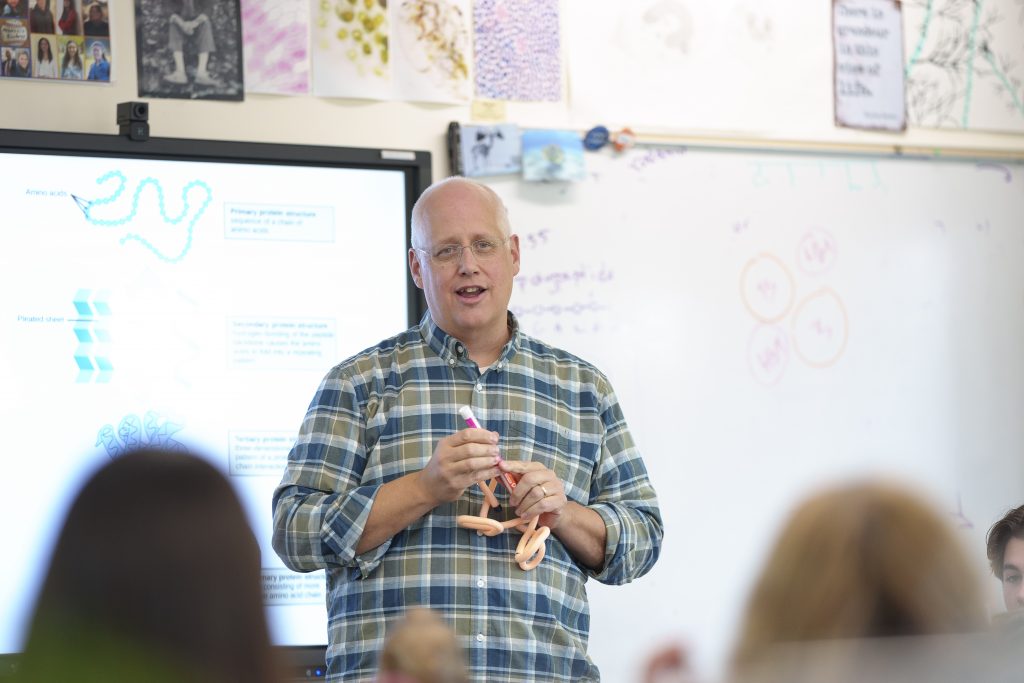
Additionally, the type of research students conduct in Edgar’s and Seplaki’s courses is becoming more central to medical treatment. For example, DNA sequencing is changing both how diseases are diagnosed and treated, allowing for more specific diagnoses and targeted therapies. “Even if students don’t do the sequencing or don’t go into science, if they have experienced that and know a little bit about it, it makes them better at evaluating that information as a person or a patient,” Edgar says. “They’re going to be in a doctor’s office with their family members one day talking about medications and the side effects of those medications. It’s important to be able to ask questions and to understand mechanisms of medicinal therapies,” Seplaki adds.
The science in both genetics and disease biophysics is advancing rapidly, which means that the courses at Milton are different every year. “It’s going to be an ever-evolving curriculum, which is, to be honest with you, what makes it appealing to me,” Seplaki says. “I am constantly learning new things.”
Grace Tatter is a journalist and writer living in Brooklyn. She produces podcasts for WBUR and Boston’s NPR, and her work has appeared on NPR and in Harvard’s Ed. magazine.