



Learning in Harmony

In the Lower School, Milton’s youngest musicians gain confidence and find their own rhythm.
Story by Marisa Donelan
As its screaming crowd of superfans cheered and held signs, the Undecided took its biggest stage yet. The rock band was opening Milton’s first-ever “Quadchella” music festival to kick off this academic year, on a ticket with several other student and professional performers.
The Undecided brought the house down with a set of classic-rock covers and originals. And they had just started fifth grade.
The band is the happy outcome of a Lower School music program, led by teacher Beth Sorrentino, that seamlessly mixes pedagogy and performance and encourages students to deeply mine their interests. During Sorrentino’s first year at Milton, she heard Tommy—the Undecided’s guitarist, who was then in third grade—play, and let him use the music room to practice during any spare moment.
“He and other friends would show up at my door at recess because they wanted the chance to play, and they kept coming back,” says Sorrentino. “It turned into a pretty big jam session with anywhere from four to 12 kids playing music. Langston picked up the drums, and Calvin joined in on vocals. The three of them have stayed working together and writing their own material, as well as playing covers. At this point, I’m just sitting back and watching them blossom as a group.”
Playing in the festival was an opportunity for the young musicians to connect with the community-building experience of performance—the etiquette involved in sharing a stage and equipment, working with a sound crew, and being responsible for important parts of the audience experience.
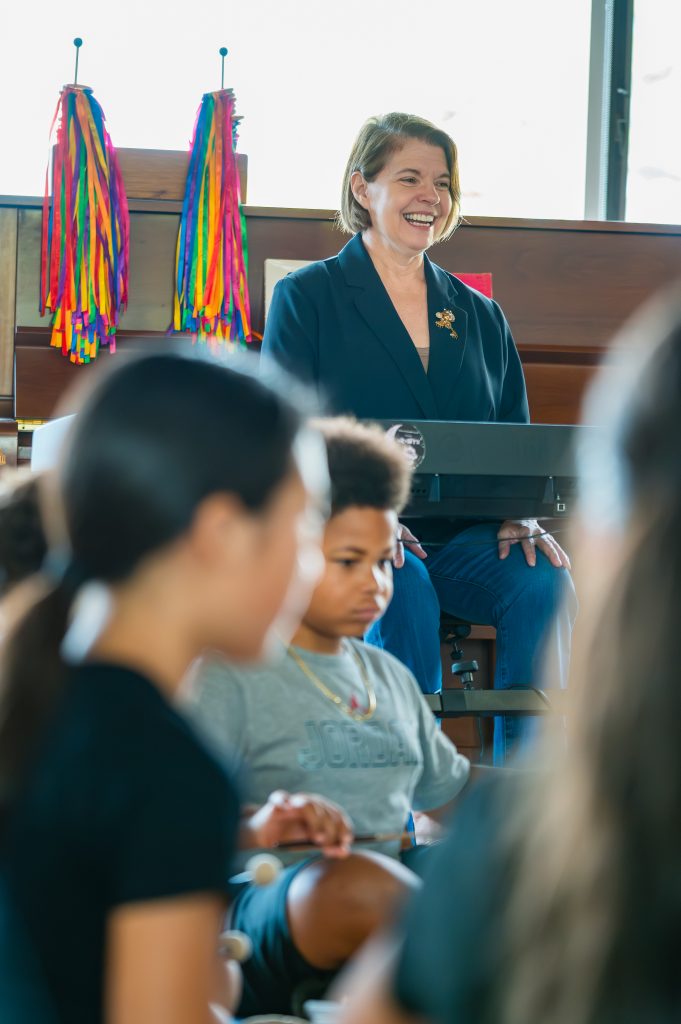 The band’s evolution is emblematic of Sorrentino’s approach: exposing students to all the different possibilities music instruction and performance hold and encouraging them to explore. For the Grade 5 concert last spring, Sorrentino and the students wrote, designed sets for, and performed an entirely original musical—a time-traveling adventure through their memories in the Lower School.
“It was an opportunity to try something they might not have realized they could do,” Sorrentino says of the musical. “Even if they didn’t want to be on stage singing, they could play a valuable role in working on lighting, or refining the script and keeping everyone organized. They all felt empowered to do whatever they could to make the production happen.”
“I want to center the kids and their interests and experiences,” she says. “Infusing as much original, creative thought into a project means that I have to listen to and amplify their voices—by doing that, we can explore all the possible angles of what the students are capable of doing, and we build on those projects together.”
Milton views co-curricular and special activities as necessary complements to academic courses and an important component of the program for students of all ages. Participation in offerings outside the academic classroom—art, athletics, robotics, culture clubs, and community engagement—benefits students of all ages.
A century of research has shown that these benefits are broad in their scope: Activities promote curiosity and confidence as well as leadership, time-management, language, and math skills. Participating in community events, like concerts, fosters stronger relationships among students and their peers, as well as with the larger community, including parents and friends.
Preparing for and delivering a musical performance gives students a tangible outcome that results from their musical learning, motivating them to improve their skills and to feel successful, concluded a 2021 study in the Journal of Research in Music Education.
“Music connects our entire community,” says Head of School Alixe Callen ’88. “When our youngest students take the stage and feel the support of all their older peers, when they get that applause, they know they’re an important part of Milton. It takes a lot of courage to perform in front of a thousand other students, and these moments build their confidence and validate their hard work.”
Recently, the school has become more intentional about planning time for clubs, activities, and community events during the school day, giving students the flexibility to explore their interests and passions—and to see them as vehicles for belonging. Students in all grades perform throughout the year, lead discussions and assemblies on topics of special interest, and have moments to see themselves as difference-makers, whether they’re in kindergarten or their senior year, says Callen.
“We give students the opportunities to take creative risks in an environment that is eager to celebrate,” Callen says. “Even when things don’t go perfectly, the support they receive from our community encourages them to make adjustments and try again. It motivates them to be bold.”
When Sorrentino introduces a song to students, she balances a pedagogical approach—pointing out rhythms and chord progressions, and asking students to identify individual instruments and parts—with performance tips, adjusting the dynamics of volume and harmony, and coaching singers on their diction. 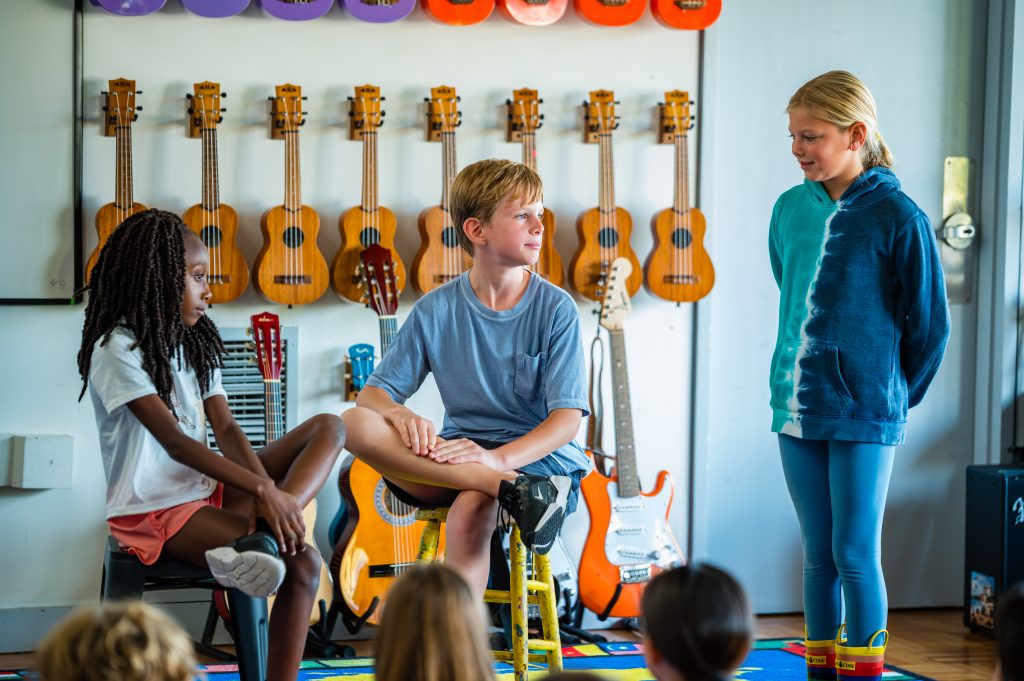
By listening intently and dissecting the different parts of a piece of music, students develop their academic understanding of the work while building an appreciation of the art form. “I ask them to consider ‘What’s the buy-in for us as listeners? What sparks our imagination and makes us want to hear more? Or what do we not like?’”
During a class in September, she plays “When the World Is Running Down, You Make the Best of What’s Still Around” by the Police. She asks students to notice the bassline, the mixing on the vocal track, and the lyrics. While they listen, Langston jumps on the drum kit and mirrors Stewart Copeland’s beat. Printed lyrics in hand, the other students sing along, learning the melodies for the verses and chorus within a matter of minutes. Different parts resonate for different students: One student wonders how the song would sound with the addition of a keyboard, while another—studying the 1980 lyrics—asks, “What’s a VCR?”
“Some of our kids are really interested in recording and audio and tech, so it’s great to introduce them to music from before the days of digital recording. Other kids just want to know how Sting got his hair like that,” Sorrentino says. “And if they don’t connect to the song, maybe we won’t do it again. But one student said to me—and this feels like a success—‘This is a low-key vibe and I really like it.’”
In 2023, Sorrentino and JoAnn Brown, the Lower School’s dean of teaching and learning, started a small but enthusiastic glee ensemble with fifth-graders, which has now expanded as an opt-in group for fourth-grade students.
About 40 students pack into the music room to practice singing the Beatles’ “Blackbird” in harmony. Those who play instruments may have an opportunity to accompany the vocals, Sorrentino tells them. But as they learn the song, their first objective is to operate as a cohesive team: listening carefully to one another, watching the cues as she directs them, and properly enunciating the words. Once it’s time for them to perform, they’ll have mastered the skills to give them confidence. Brown, a talented singer, lends her voice to a flourish in the chorus. The students are impressed and pause to applaud.
“I want them to understand that it’s OK to be a little nervous before performing, because that means they care,” Sorrentino says. “Music is such a centerpiece at Milton and every division has its own way of shining a light on it. Our youngest students have shown me time and time again that if they have the tools and the opportunities, what they can create is unbelievable. It’s just miraculous.”