




Lessons in Legacy
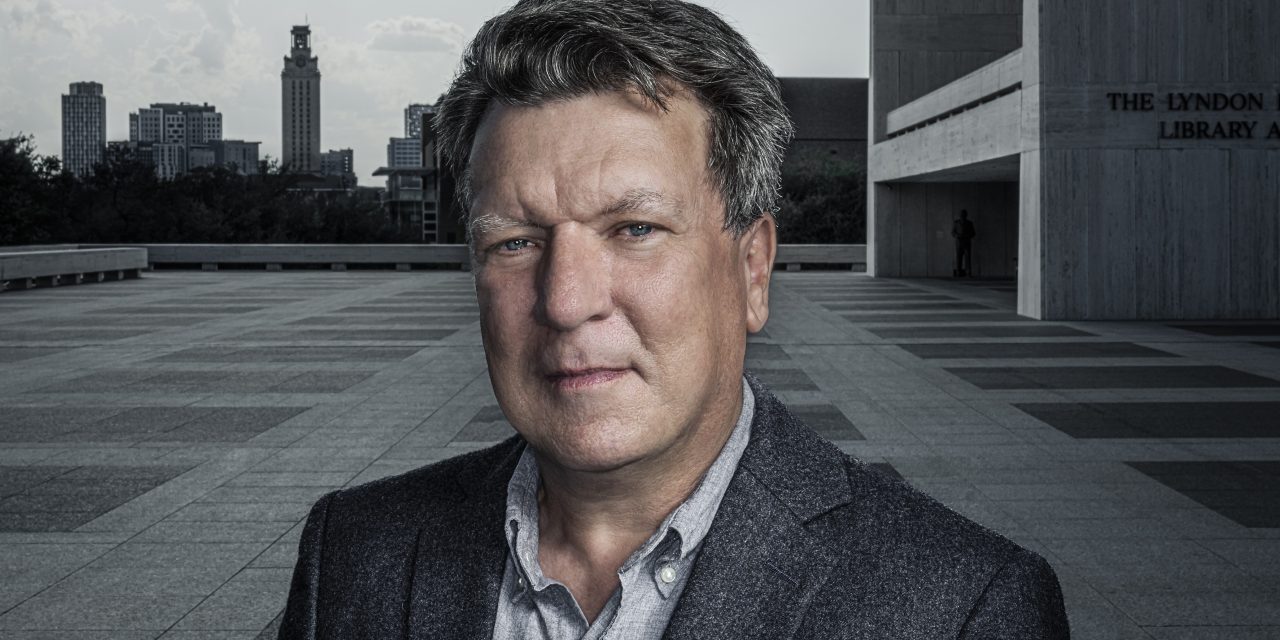
A fascination with the rapid changes of the ’60s and ’70s—and a term leading the Lyndon B. Johnson Presidential Library—give historian Mark Atwood Lawrence ’84 a keen perspective on leadership during extraordinary times.
Story by Richard Babcock
Photographs by Dan Winters
Mark Atwood Lawrence ’84 grew up in a family so excited by history that they spent vacations visiting American landmarks—Gettysburg, Jamestown, and other sites rich with the past. This was the 1970s, and the country was just coming out of one of the most traumatic and dynamic periods since its founding. Echoes of the Vietnam War were in the air, and Lawrence’s father—a Congregational minister in the Fall River, Massachusetts, area—sometimes dealt with issues left over from the conflict.
Those paths came together for Lawrence at Milton Academy in a tough and inspirational U.S. history class taught by John Warren, who pushed his students to think hard about the lessons of Vietnam. “It was a very, very rigorous class,” Lawrence recalls. “For so many people who go into academia, it’s that individual, inspirational teacher who really plants the seed.”
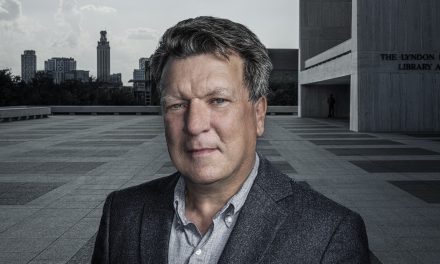
An interest in history and a focus on Vietnam: This combination has propelled Lawrence, 59, into a distinguished career as chair of the history department of the University of Texas at Austin and the author of three acclaimed books on Vietnam and President Johnson. He’s also a recent former director of the Lyndon Baines Johnson Presidential Library, having stepped down last fall after almost five years.
“I was eager to lead the library in part because LBJ is surely one of the most fascinating, complex presidents of recent times—maybe at the top of the list,” he says.
Lawrence’s dedication to the exploration of history in all its nuanced multiplicity comes at a time when the subject, which occasionally involves the study of battlefields, has become a battlefield itself. Fierce disputes over what should be taught and how America’s story should be interpreted have erupted around the country. As someone who has grappled with the strident divisions over President Johnson’s legacy, Lawrence has witnessed how perspectives can become a political weapon. “Historical knowledge changes, evolves, gets rebutted, and overturned, and all those processes are healthy,” he says. “I think what can be less healthy is when assertions are made about history without grounding in evidence and rigor.”
Still, he sees value in argument itself: “People are really locked in on historical controversies in a way that I think was not the case 10 or 20 or 30 years ago.” In this historian’s view, the country faces a learning moment that could advance everyone’s understanding of the complexities of the past.
Fredrik Logevall, the Harvard history professor who taught Lawrence at Yale and remains a friend, seconds Lawrence’s view. “I think both of us feel strongly that to a democracy, historical knowledge is essential—that history is a kind of collective memory,” he says.
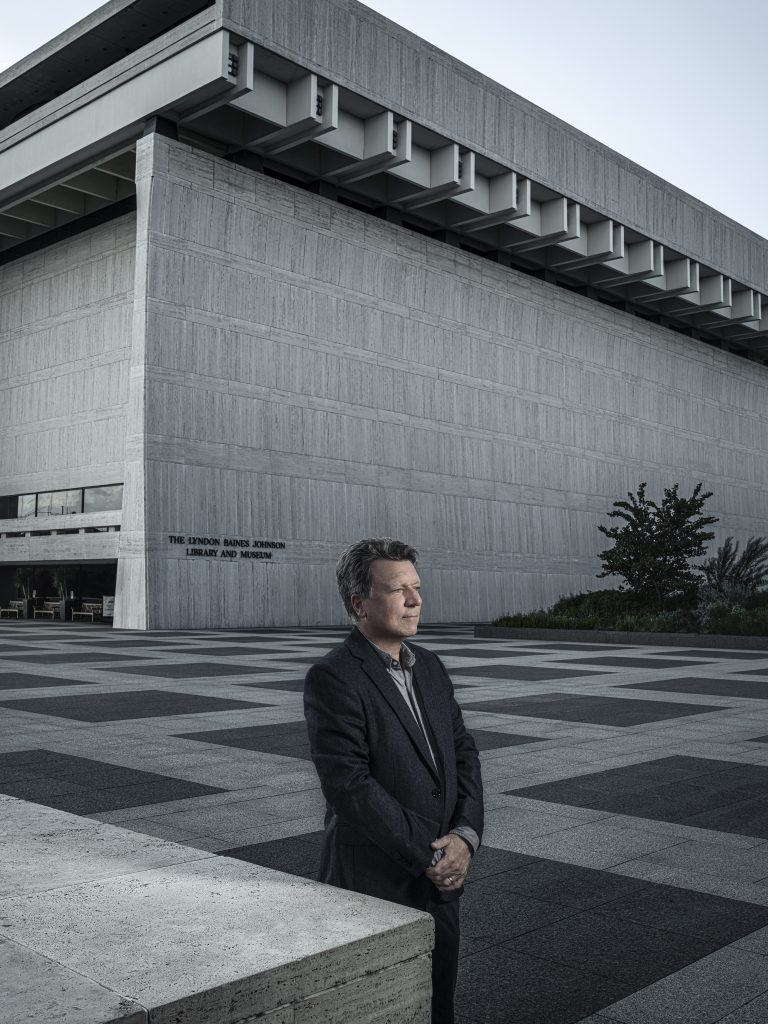 Learning and teaching lie at the heart of Lawrence’s career. To speak to him is to recognize the truth of William Faulkner’s famous dictum: “The past is never dead. It’s not even past.” Lawrence sees strong connections between the political disillusionment felt by many Americans today and the failure of the government to deliver on the country’s promise after World War II. “Lyndon Johnson was president at a moment when that postwar sense of confidence—the belief that no problem lay beyond the ability of the United States to solve—ran at its absolute highest,” he says. “That’s ultimately LBJ’s significance. He was the president who sat in the Oval Office at the absolute apogee of that sentiment.”
Lawrence admires Johnson’s remarkable record of domestic achievements: the Civil Rights Act, the Voting Rights Act, Medicare, Medicaid, the War on Poverty, and a range of federal contributions to education and the arts. Some of those programs are being challenged or dismantled today, and Lawrence acknowledges that some of their aims were introduced with a “grossly misplaced sense of confidence.” Johnson “doesn’t just say he’s going to work on poverty. He says he’s going to cure poverty.”
The chief lesson from that era, Lawrence maintains, is that “good public policy, whether in connection with domestic problems or international problems, is really, really difficult. And there are tight limits on the ability even of an enormously powerful country like the United States to achieve everything it wants to achieve in the world.”
The reverberations of that lesson are felt in today’s widespread intense skepticism toward institutions, “very much including the institutions of government,” he says. Lawrence entered Milton in 10th grade as a boarding student. Warren, the teacher who helped inspire his career as a historian, remembers him well. “He was one of those kids who could really give you a nugget of insight that would take the conversation to the next level,” recalls Warren, who recently retired as head of school at St. Mark’s School in Massachusetts. “He had a maturity, a sophistication of thinking that was extraordinary.”
While Lawrence pursued his interest in history, he also made time to run cross country and track. “Maybe the biggest thing that happened to me at Milton was being elected captain of the cross-country team in my senior year,” he says.
He went on to Stanford, earning a B.A. and master’s in history, but then ventured into journalism, working for the Associated Press in Brussels. As a news reporter, he found plenty of action—the Balkans were erupting, the European Union was launching. He thought he might have found his career. “I loved journalism,” he says.
But his delight in history lured him back into academia. His dissertation at Yale focused on the years leading up to the Vietnam War, when concerns about colonialism got subsumed by the Cold War. The dissertation became his first book, Assuming the Burden (2007).
Logevall points out that Lawrence’s journalism training paid off. “He’s a very good stylist,” says Logevall, who is working on the second volume of a biography of John F. Kennedy. “As a journalist, he had learned how to be concise and clear.” Lawrence joined the faculty at the University of Texas at Austin in 2000, where he met his wife, Stephanie Osbakken, a sociologist who teaches at the university. They have two young daughters.
His scholarly work had focused on Vietnam in the era before Johnson became president. But with the LBJ Library on campus, he now had a stupendous resource—50 million pages of documents, among other things—almost next door. His attention turned to the Johnson era, and along with a thick shelf of articles and collections of essays and documents, he published two more books: The Vietnam War: A Concise International History (2008) and The End of Ambition (2021), which shows how the Vietnam War and domestic turmoil crushed liberal hopes to improve lives in developing nations.
“Over almost 20 years, I became more and more involved in the library and thought of it as a second home on campus,” he says. When the director’s job opened in 2019, UT gave him a leave, and he stepped into the role.
The library, opened in 1971, is jointly run by the National Archives and Records Administration and the LBJ Foundation. Upwards of 120,000 people visit each year. In addition to the trove of records from the Johnson Administration, the facility features exhibits about Johnson’s life and presidency, including an extensive display on the Vietnam War. LBJ’s escalation of the conflict proved disastrous for the United States and darkly colors Johnson’s legacy.
“LBJ was a very conventional thinker about foreign affairs who drew simple lessons from the Second World War,” Lawrence says of LBJ’s foreign policy. Most American leaders of the time worried about the risks of appeasement and the necessity of containing communism. A few advisers told Johnson the war was a terrible mistake. “But he didn’t have the political courage in the foreign affairs arena to do the kinds of things he was willing to do domestically,” says Lawrence.
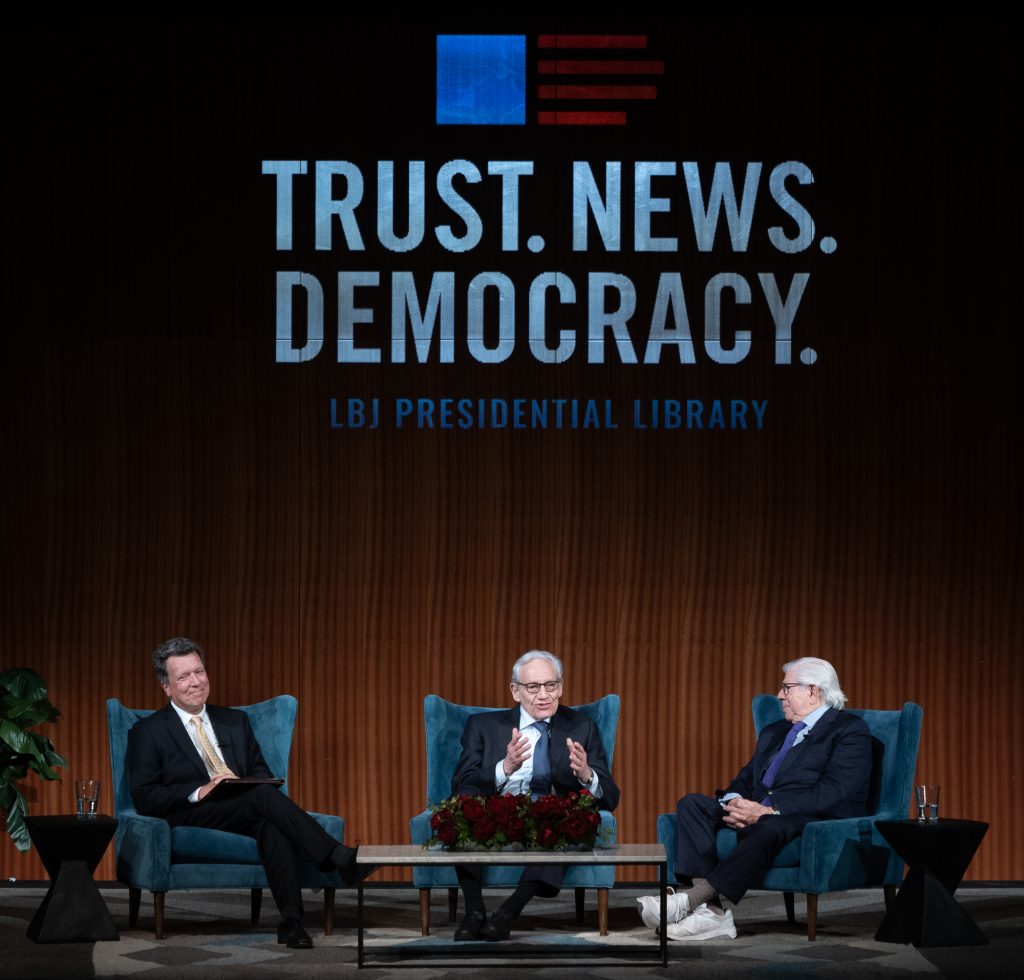
Lawrence, left, moderated a 2024 discussion with investigative journalists Bob Woodward (center) and Carl Bernstein (right) about the Watergate scandal and its echoes across history. Photo courtesy of Mark Lawrence.
The library’s Vietnam exhibit doesn’t ignore criticisms of the war but tries to present the Johnson Administration as a nuanced story. “The best way to get Americans to think seriously about the American presidency across the board, and with LBJ in particular, I think, is not to go in with all guns blazing and to flag every flaw and every ugly side of the administration,” he says.
To date, there are 13 presidential libraries, and Lawrence acknowledges that some critics say they go too far in glorifying their presidents. The passage of years, he argues, gives libraries the distance to offer more critical perspectives. As director of the LBJ library, he led the effort to overhaul and update its displays. “That project’s actually not quite finished yet, but ultimately it will replace 50 or 60 percent of the main exhibit about LBJ’s presidency,” he says.
Running the library entailed a smorgasbord of responsibilities—working with a staff of archivists, overseeing the education program, bringing in speakers, and so on—but updating core exhibits was the highlight for the historian in him. “It’s where I really got to bring to bear my own reading, my own insights about LBJ.”
He says he never received any pressure from the LBJ Foundation, even though Johnson’s two daughters are on the board and the foundation contributes a significant portion of the library’s budget. “I think, frankly, we would agree on both sides—the federal and foundation sides—that there needs to be more attention paid to Vietnam and to 1968, some of the more difficult moments of the Johnson presidency,” says Lawrence. “And those themes are more represented in the refreshed exhibit that will open next year.”
In fall 2024, the University of Texas enticed Lawrence back with an offer to chair the History Department, a multifaceted role that also gives him time to work on his next book, an account of the 1976 presidential election. He’s excited about what he calls “this amazing cast of characters,” ranging from Jimmy Carter, Gerald Ford, Ronald Reagan to George Wallace, among others. He also argues that the era in some ways resembles our political times, with extreme doubt about institutions across the board, diminishing trust in public authority, and economic downturn. “The mid-1970s,” he says, “really rhyme in a lot of ways with our own times.”
Exploring connections like that is one reason Lawrence values the study of history. “It helps us explain ourselves, right? How we got here, what were the choices, what were the missed opportunities. Historical knowledge is essential for citizenship,” he says.
He also cites an almost opposite attraction: “History enables you to see places and times that are totally unlike our own world.” He talks about walking around in the shoes of someone in the Roman Empire or early modern France or the Vietnam War as a way to imagine the past both as a mirror of the present and as an alien universe.
“That’s one of the cool things about history—there’s more than one reason to study it. And I think clever people can hold multiple ideas in their heads at the same time.”
Richard Babcock’s latest novel is A Small Disturbance on the Far Horizon.