




Return on Impact

An emerging investment practice helps funders win when nonprofits make a difference. With Social Finance, Tracy Palandjian ’89 leads the way.
Story by Alexander Gelfand
Photographs by John Huet
“I’m not a planner,” says Tracy Palandjian ’89.
On its face, this seems absurd. A native of Hong Kong, Palandjian studied business and economics at Harvard after attending Milton, became a management consultant specializing in nonprofits, and ultimately founded the American branch of Social Finance, a nonprofit that partners with the public and private sectors to design and fund projects that address pressing societal problems. Along the way, she helped develop the field of impact investing, or investing with the goal of generating measurable social and environmental benefits—a field that represents more than $1.5 trillion in assets under management according to the Global Impact Investment Network, an international nonprofit dedicated to championing impact investing.
It’s possible, of course, that Palandjian is joking: She has a near-perfect deadpan and a taste for self-deprecating humor. “She’s a very low-ego person,” says Sir Ronald Cohen, the British investor and philanthropist who cofounded the original Social Finance in the U.K.
Whatever the case may be, speaking from the home in Belmont, Massachusetts, where she and her husband, Leon, raised their daughters Te ’17, Charis ’18, and Pari ’20, Palandjian is entirely earnest.
“It was one foot in front of the other,” she says. By the early 2000s, these footsteps appeared to have a destination. But it was something she was going to have to build herself.
Palandjian was at that point more than halfway through a nearly 12-year run at the Parthenon Group (now EY-Parthenon), a global strategic consulting firm. Having joined the boards of various nonprofits, she began to suspect that the nonprofit sector as a whole might benefit from an injection of the investment practices and financial innovation common to the for-profit world. 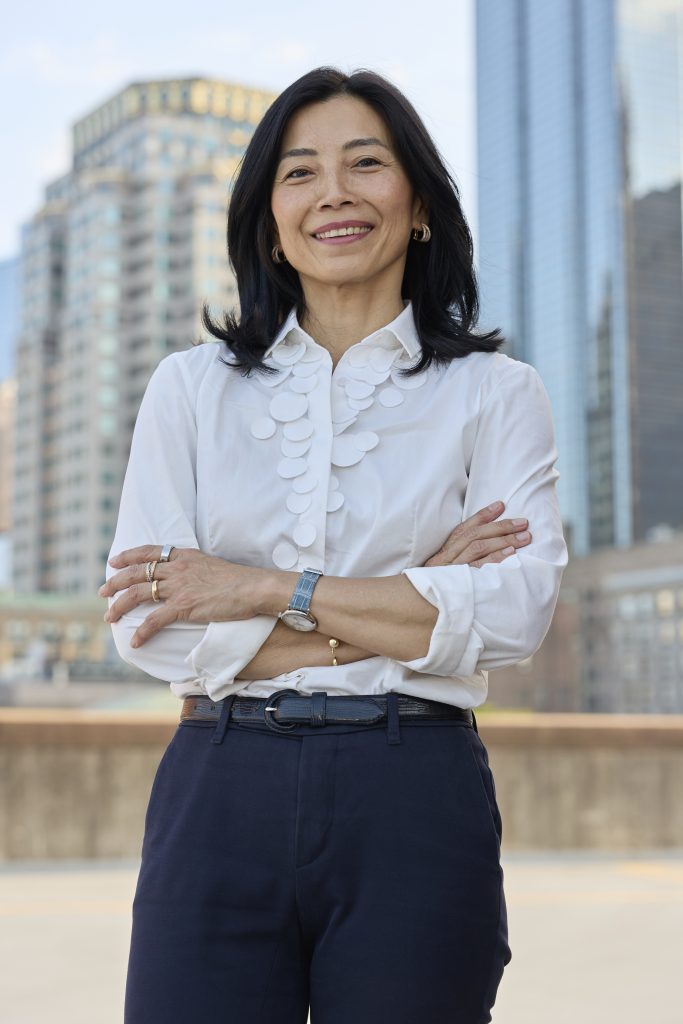
“If you could just make the nonprofit sector more business-minded, you could solve problems in a more efficient, more effective way,” she recalls thinking. The idea inspired her to launch a nonprofit consulting practice at Parthenon dedicated to helping foundations and NGOs accomplish their missions.
Palandjian became especially interested in developing financial mechanisms that could bridge the gap between traditional grant-making and market-rate investing.
Her timing was propitious. In 2007, at a meeting convened in Bellagio, Italy, by Antony Bugg-Levine ’92, the Rockefeller Foundation coined the term “impact investing” to describe a novel combination of philanthropy and investing that sought to create social and environmental benefits alongside financial returns.
The foundation subsequently commissioned Palandjian to prepare a study of the nascent impact investing space. In the process, she delineated two distinct approaches to achieving public good and private profit: finance-first, which prioritizes market rates of return over social and environmental progress (think: profit before impact), and impact-first, which prioritizes social and environmental impact over financial returns (think: impact before profit). While market-rate returns are possible with an impact-first approach, they are by no means guaranteed, nor are they really the point.
In 2008, Palandjian met Cohen, who had cofounded Social Finance with his partner, former Goldman Sachs executive David Blood, in London just a year earlier. In 2010—the same year Palandjian filed her Rockefeller report—Cohen and Blood introduced the first social impact bond, or SIB, in the U.K.
SIBs help governments raise money from private investors to solve societal problems, like low childhood literacy rates or high unemployment among the formerly incarcerated. Unlike traditional bonds, they do not pay a fixed interest rate. Instead, impact-first investors only see returns if the projects they fund achieve their goals, and those returns come from whatever money the funded projects save or earn for the government.
SIBs therefore represent a “pay-for-success” approach to social spending that ties financial returns directly to social outcomes. And just like the business models that power the private sector, they rely on hard numbers to gauge whether projects are actually succeeding.
SIBs have since been adopted by governments around the world. At the time, however, their reliance on private capital, clearly defined outcomes, and quantitative measurement were revolutionary.
“I just became obsessed with this as a really creative, powerful way to solve social problems,” she says.
When American policymakers began calling on Cohen and Blood to bring SIBs to the other side of the Atlantic, the two asked Palandjian if she might consider establishing Social Finance in the U.S.
She demurred. “I was like, ‘I am so not a startup girl. I’ve never started anything in my life. I’ve always worked in big institutions,’” she says. “Long story short, they convinced me to do it.”
When Palandjian launched Social Finance in Boston in 2010, the job was as difficult as she feared it might be. Not only did she have to hire staff, build a board of directors, and raise money to pay the fledgling organization’s bills, she also had to explain to potential investors and government partners what impact investing and SIBs were at a time when few had ever heard of them.
“The first few years of Social Finance were just as hard as coming to this country and going to Milton,” she says. “I was being challenged to the core in a similar way.”
To understand why Palandjian would say that, it helps to understand how she arrived in the United States, and how the next few years unfolded for her.
Palandjian was born into what she describes as a “very traditional Chinese family” in Hong Kong, where her grandfather fled from mainland China during World War II. Her father had attended the University of Michigan and planned to send Palandjian and her two younger brothers, Theodore ’96 and David Pun ’99, to American colleges when they came of age.
But Palandjian, who had been weaned on her father’s stories of the U.S., was not inclined to wait. While attending a private girls’ school in Hong Kong, she secretly applied to a handful of boarding schools in the Northeast. When the acceptance letters began rolling in, her parents agreed to send her to Milton for two reasons: first, it happened to be the closest to an international airport; and second, because the admissions brochure emphasized the community service program, something that deeply resonated with Palandjian. Her involvement in the program, led by Mary Wendell, would ultimately inspire her career.
The transition was difficult, not just because she was homesick. For someone accustomed to quietly receiving instruction from her teachers, suddenly having to engage in discussion and debate with her peers came as a shock. But she soon found her footing.
“I was a decent student in Hong Kong, but I never really excelled until I got to this country,” she says. “The whole idea that you could come at issues from very different perspectives and that it’s good to disagree—I just loved it.” She especially enjoyed art class: Her childhood hobbies included Chinese calligraphy and watercolor painting, and for her senior project, she painted a 400-square-foot mural in Ware Hall’s Goodwin Room. She went to Harvard to study economics, the kind of “serious-minded” major her conservative parents expected of her.
In the fall of her freshman year, Palandjian’s father died suddenly of a heart attack, leaving her mother in crisis with two young sons. “I decided that my brothers needed to be near me,” Palandjian says. So she enrolled Teddy and David in a junior boarding school in Deerfield, Massachusetts, and became their “second mom”—a role she continued to play as they completed high school at Milton, as she worked as a management consultant at McKinsey & Company, and as she earned her MBA from Harvard.
Managing school and work while mourning her father and acting as a surrogate mother to her siblings wasn’t easy. But Palandjian adopted as her maxim something her English teacher at Milton, the late Alice Perry, once told her: One can only achieve growth through suffering.
“What doesn’t kill you makes you stronger,” she says. “And my brothers and I are still incredibly close.”

Palandjian (right) with her daughters (left to right), Charis ’18, Pari ’20, and Te ’17. Photo courtesy of Tracy Palandjian.
When Palandjian launched Social Finance in Boston, she initially focused on implementing SIBs of the sort Cohen and Blood had pioneered in the U.K. But it wasn’t long before she began introducing innovations of her own.
For example, Palandjian partnered with governments and philanthropies to create new funding mechanisms for programs designed to help low-income individuals find better-paying jobs while filling labor shortages in fields such as technology, health care, and the skilled trades.
The organization’s latest initiative, ReNEW (Reinvesting in Nursing Education and Workforce), aims to raise $100 million to provide grants and zero-interest loans to help tens of thousands of people across the country earn nursing degrees. ReNEW makes use of two innovations Palandjian first introduced in Pay It Forward workforce development programs: Students only repay their loans if they land jobs that meet a minimum earning threshold, and whatever they repay is used to support other students, creating a self-sustaining financial recycling system.
Such “revolving funds” do not necessarily provide returns to investors, but they represent a breakthrough for governments and philanthropies that want to maximize the value of every dollar they spend, especially since most social programs require constant infusions of fresh cash. Palandjian also transformed Social Finance into what Cohen calls “an investment bank in the impact space.”
The organization helps individuals and institutions make impact investments and manages its own Impact First Fund, which invests in a portfolio of enterprises that pursue specific social and environmental goals. The fund has poured millions into initiatives like the Blackstar Stability Distressed Debt Fund, which helps low- and moderate-income families convert predatory home loans into conventional mortgages, and RuralWorks, which invests in companies that create jobs and benefit the environment in rural communities.
There is poetic justice, and perhaps no small amount of irony, in using the tools of capitalism (private capital, financial markets) to repair the damage (economic inequity, environmental degradation) that capitalism itself has wrought. Cohen believes the multifaceted approach to impact investing that Palandjian has pioneered in the U.S. represents the future of the field—especially if governments offer financial incentives to expand such efforts, as they have begun to do. In 2018, for example, Congress appropriated $100 million to support local and state pay-for-success initiatives.
“If investors and businesses are measuring their impacts, and governments are guiding them through incentives, then your economy begins to solve problems rather than create them,” Cohen says.
Under Palandjian’s leadership, Social Finance has already raised more than $500 million and employs more than 120 people in five cities. But given the scale of the societal problems she is trying to address, her main goal is to further expand the work that the organization does—and to see impact-first investment, which she says represents a “tiny sliver” of the overall impact investing space, become more widely adopted.
“Wouldn’t it be great if these practices became the norm?” she asks. “As a naturalized citizen, I believe this is the most American way to solve problems: It’s entrepreneurial, creative, using market tools to address the very challenges markets have helped create, and always about testing and learning to do better.”
Alexander Gelfand is a freelance journalist living in New York City whose work has appeared in such publications as Wired, The Economist, and The New York Times.